Ring your mother tonight and let her ask if you've eaten.
Every morning, Meenira calls your parent in their own language, has a warm little chat, and tells you how they are — so your call home can go back to being a call home.


Evening where you are; the small hours before their morning.
The distance
You call. It rings out. And you spend the rest of the day imagining the worst.
They were fine, of course. The phone was in the other room, or the volume was down, or they'd gone to the market. By the time they call back, you've already pictured a fall, a hospital, a stranger answering. Eleven minutes of quiet, and your whole afternoon turned over.
This is what the distance does. Not the emergencies — those are rare. It's the ordinary silences that pull at you, day after day, from another time zone.
And when you do get through, the call isn't really a call.
Did you take your tablets? Did you eat? What did the doctor say? You love them, so you check on them — and somewhere in the checking, the conversation you actually wanted disappears. You put the phone down having covered everything except how they are. It feels less like talking to your mother and more like taking a register.
You didn't move away to become a caseworker over the phone. You just wanted to know they're alright, so you could go back to being their child.
How it works
Four small things, and then it just happens every morning.
There is nothing for your parent to set up, download or learn. They answer the phone, the way they always have.
You set it up in a few minutes
Tell us your parent's name and number, the language they are most comfortable in, and the time of day that suits them. Add a few things worth asking about — their knee, whether they have eaten, the tablets after breakfast. That is all we need to begin.
She calls every morning, in their language
At the time you chose, Meenira telephones and speaks to them warmly in their own language — one of eleven. She says who she is, that she is your assistant, and that the call is being recorded. Then she simply has a short, unhurried conversation. No app to open, no button to press.
She remembers
She carries yesterday into today. If the knee was hurting, she asks how it is now. If a grandchild was visiting, she asks how the visit went. Your parent is met as a whole person with a life going on — not asked the same questions by a stranger each day.
You get a clear message afterwards
A little while later, a plain message reaches you on WhatsApp or SMS: how they sounded, what they said, anything worth knowing. On an ordinary day it is a quiet reassurance. And if something seems wrong, we ring you straight away.
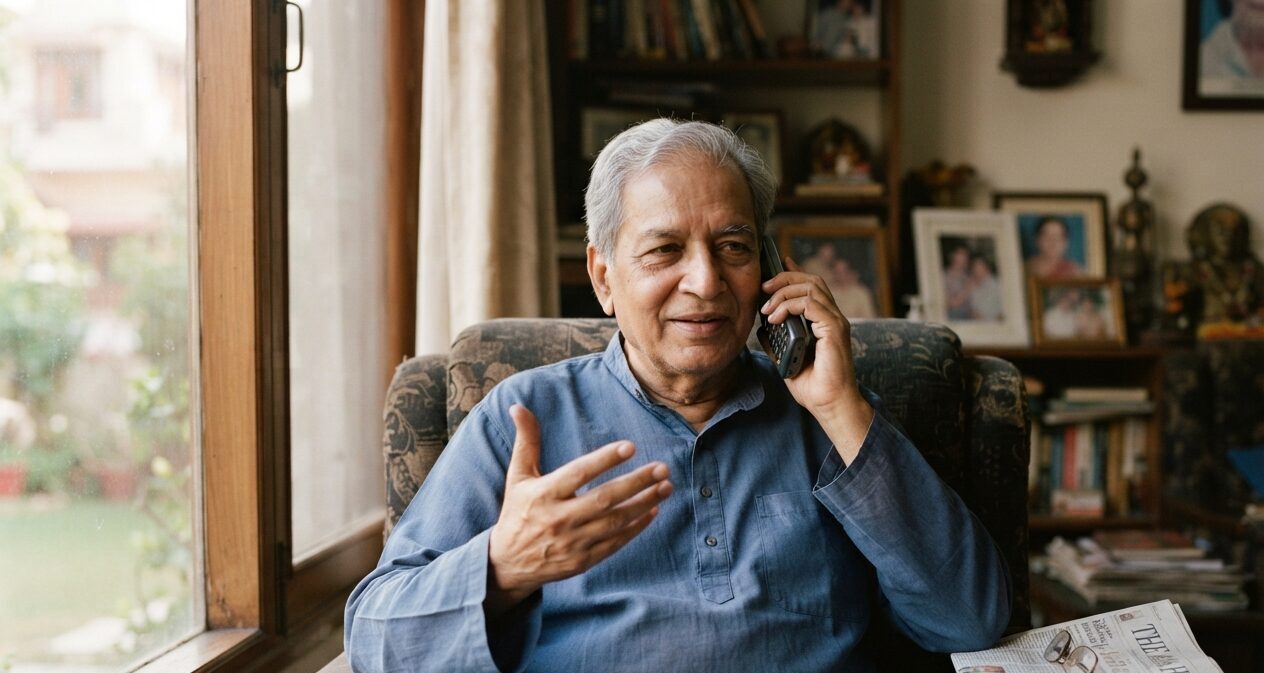
No app, no button. The phone rings; they answer.
Hear it for yourself
A real morning call, in your language.
You don't have to sign up to hear how it feels. This is the same warm, unhurried conversation your parent would have — choose a language, then press play.
Would you rather hear her on your own phone? Have her ring you now →
Sample conversations, voiced for the demo. On a real call she speaks live and remembers what your parent tells her.
Trust
The honest part
This is the page we'd want to read first. So here is everything, plainly, before you decide.
She is not a doctor, and not an emergency service.
Meenira listens, remembers, and tells you how your parent seemed. She does not diagnose, does not give medical advice, and cannot call an ambulance. If something sounds wrong, she tells you quickly so that you can act. The judgement, and the care, stay with your family and your doctor — where they belong.
Your parent is told, every single call.
At the start of each call, in their own language, Meenira says who she is, that she is your assistant, and that the call is being recorded so the family can be told how they are. Nothing is hidden from them. They are never listened to in secret. A parent who doesn't want to talk today can simply say so, and that is fine.
The recording of her voice is never kept.
Once the call is turned into words, the recording is deleted. We do not store the sound of your parent's voice. The written notes — what was said, how they seemed — are kept for thirty days so the family can look back over a week or two, and then they too are gone.
She never pretends to be a person.
Meenira introduces herself as your assistant, not as a friend, a nurse, or a relative. Her voice is warm because a cold voice would be unkind to talk to — not to fool anyone. Your parent always knows they are speaking to something you set up for them, out of care.
You can stop, any time.
Pause the calls, change the time, or end it altogether whenever you like — in a moment, with no reasons asked. If you stop, we delete the notes. Trust is the whole of what we're selling, and it only works if leaving is as easy as arriving.
If any of this ever stops being true, we'd rather lose you as a customer than keep you without your knowing. That is the promise the rest of Meenira is built on.

Nothing hidden, nothing kept that needn't be.
Her language, her way
She speaks to your mother in your mother's tongue.
Not a translation. The real thing — spoken warmly, and spoken correctly.
Meenira talks in eleven Indian languages. She doesn't ask your mother to meet her halfway in English. She begins in the language your mother thinks in, dreams in, and scolds the neighbours in.
And she gets it right. In most of these languages the words change shape depending on who is speaking and who is being spoken to — the verb your father uses is not the verb your mother uses. Meenira knows the difference. She addresses your mother the way your mother's own family would, with the right grammar and the right respect. It is a small thing that is not small at all: it is the difference between being spoken to, and being spoken at.
Company, not surveillance.
This is the part we care about most, so we'll say it plainly. Your mother is not a patient. She is not a case, or a dashboard, or a problem to be monitored from far away. She is a person with a long life behind her and a full one still going — opinions, routines, a favourite chair, strong views on how tea should be made.
Meenira calls to keep her company, not to keep watch over her. The conversation is hers to lead. If she wants to talk about her knee, they talk about her knee. If she'd rather talk about the wedding next month, or the serial she won't miss, or the son who never calls enough — that is the call. Meenira is unhurried. She has nowhere else to be.
"We measure ourselves by one thing: does your mother look forward to the call tomorrow? A person you look forward to hearing from is company. Everything else is surveillance with a nicer voice."
So yes — she remembers, and she tells you how your mother is doing. But she earns her place in your mother's morning the honest way: by being someone worth talking to, in the language that has always been hers.

A person with a full life — met in it, not watched over it.
Simple, honest pricing
Your first month is free.
Two warm check-in calls a week for a whole month — eight calls — on us. After that, plans start at ₹300 a month. No setup fee, no contract, cancel any time.
One price a month, and you choose how often she calls — twice a week, every other day, or every morning. Each time she has a warm few minutes with your parent, then sends you a short summary — with a call to you straight away if something doesn't sound right. Nothing to decode.
Think of it the way you'd think of a good neighbour who looks in each day. It won't replace your evening call — it's the reason that call can finally be about the cricket, or the grandchildren, instead of medicines and blood pressure.
We'll place a short demo call — to your phone, or to your parent's with your say-so — so you can hear exactly how she sounds and what she says before you decide anything. Cancel any time, in a tap, no reason to give. And your parent is always asked first: on every call she says who she is, who she's calling for, and that the call is being recorded. If they'd rather not talk that day, that's fine — she'll simply try again tomorrow.

Not vigilance — relief. The morning's news, already good.
The distance won't close. But tomorrow morning, you could wake up already knowing they're alright.
Questions families ask us
The honest answers. If something here still worries you, write to us before you sign up.